

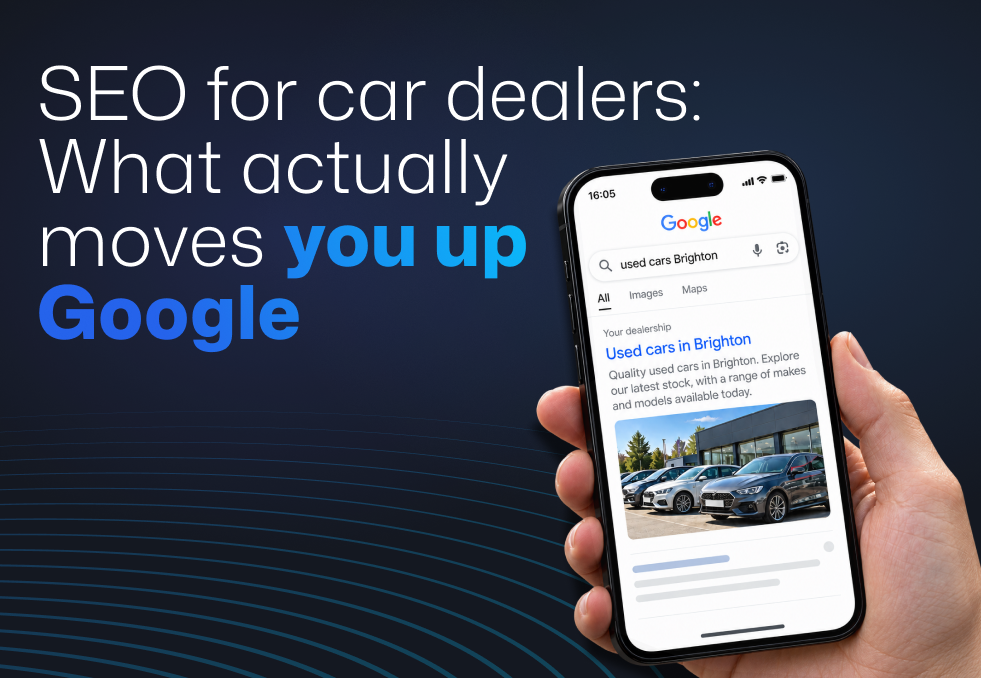
SEO for car dealers: what actually moves you up Google (and what doesn't)
Table of contents
Most dealers we speak to fall into one of two camps.
Either they know they should be doing something with SEO but are not quite sure what it involves, or they already have someone working on it and would like a clearer picture of what it is doing for them.
Both are completely normal places to be. SEO has a lot of moving parts and a vocabulary all of its own, and very little of it is written for people whose actual job is selling cars. So here is a plain-English version for anyone running a forecourt: what genuinely moves you up Google, what matters less than people tend to assume, and how to tell the difference without becoming an expert yourself.
What SEO actually means for a dealer
Strip away the jargon and SEO is one thing: being the dealer that shows up when someone nearby is searching for the kind of cars you sell.
Showing up nationally, or ranking for “used cars”, may seem like the ultimate goal. It will generate the most traffic based on search numbers, but in reality, it's increasingly difficult to outrank the big portals, and more often than not the traffic will have lower intent to enquire, so you aren't getting genuine customers coming to your website.
Showing up when a buyer twenty minutes away types in the make and model you happen to have sitting on your forecourt, or searches for a used car dealer in your town is much more beneficial to you, and much easier to achieve. Everything below either helps that happen or it doesn't.
What actually moves you up
1. Being genuinely findable in your own area
Local search is where almost all realistic dealer opportunity sits. That means your Google Business Profile being complete and active, your address and phone number being consistent everywhere they appear, and your website clearly stating the areas you serve.
It sounds basic. It is also the single most common thing we find missing when we audit a dealer's site.
2. Your stock pages being findable
This is the one that separates dealer SEO from ordinary business SEO, and it is where most templated websites quietly fail.
Every vehicle on your forecourt is a potential entry point to your website. Someone searching for a specific make, model and year should be able to land directly on that car's page on your site. If your vehicle pages load slowly, cannot be indexed properly by Google, or disappear and reappear every time your stock updates, you are invisible for hundreds of searches a month that you should be winning.
A well-built dealer website handles this automatically as your stock feed updates. A generic one often does not. We covered the wider version of this in why most dealer websites fail to generate leads.
3. Speed and mobile, because Google measures both
Most of your buyers are browsing on a phone, often in the evening, often comparing you against two or three other dealers at the same time. Google knows this, and it factors how quickly and cleanly your site loads on mobile into where it puts you.
You do not need to understand the technical details. You need to know that a slow, awkward mobile site costs you rankings as well as enquiries. If you want the detail on the experience side, the role of UX in automotive web design covers it.
4. Content that answers what buyers are actually asking
Google rewards sites that genuinely answer questions. For a dealer, that does not mean churning out blog posts about the history of the motor car. It means covering the things your customers ring up and ask: how part exchange works, what your finance options are, what happens to the warranty, whether you deliver.
Useful, specific, local. That is what gets picked up.
5. Trust signals
Reviews, clear business information, finance partner logos, real photography of your actual forecourt. These help your rankings indirectly, because they keep people on your site and encourage them to get in touch rather than bouncing straight back to Google. More on that in creating trust with car dealership websites.
What matters less than people tend to assume
A few common assumptions are worth clearing up, simply because they are where time and budget often go without much to show for it.
- Chasing national rankings. Ranking for "used cars uk" sounds appealing, but it is rarely a realistic or useful goal for an independent dealer. You would be competing with national portals for traffic that is potentially not at a final buying stage. Owning your own area is both more achievable and worth considerably more.
- Stuffing keywords into your pages. Writing "used car dealer in Brighton" fourteen times on your homepage does nothing except make the page harder to read. This was an effective tactic many years ago, and Google moved past it a long time ago.
- Buying links in bulk. Cheap bulk link packages are one of the few things in SEO that can actively harm your visibility rather than simply not help it. Links earned properly are valuable, which is exactly why the shortcut version tends to backfire.
- Publishing content for the sake of it. Thin, generic posts that nobody is searching for will not move you. One genuinely useful page that answers a real customer question is worth more than twenty that do not.
- Rebuilding your website every couple of years. Each rebuild can reset hard-won progress unless the migration is handled carefully. Consistency usually beats novelty.
How to tell if your SEO is actually working
You do not need software or a monthly report full of charts to sanity-check this. Three questions will tell you most of what you need to know.
- Are you getting more enquiries from the website than you were six months ago? Not more visits. More phone calls and form submissions. Traffic that does not convert is a vanity number.
- Can you find yourself? Open your phone, search for the kind of cars you sell plus your town, and see where you appear. Then search for a specific car on your forecourt by make, model and year. If you cannot find yourself, neither can your buyers.
- Can someone explain it to you in plain English? You should be able to ask what changed this month and what it produced, and get an answer that makes sense to you. If a report leaves you none the wiser, it is always fair to ask for a simpler version. Any good provider will be happy to give you one.
Good questions to ask any SEO provider
If you are choosing a provider, or taking stock of the one you already work with, these four questions will give you a clear picture quickly. They are fair questions to ask us, too.
- What will actually change, and roughly when? Ask what work is planned on the site and when you might reasonably expect to see movement. SEO takes time, so a straight answer about timescales is a good sign.
- How will we measure it? Agree up front that success means enquiries rather than rankings alone. It is quite possible to climb the rankings and still not generate business, so it is worth being clear from the start.
- Do you work with stock feeds? Automotive SEO is a specialism. A provider who regularly deals with dealer vehicle feeds will be far more comfortable with the part that matters most to you.
- Who will I be speaking to? This work goes better when you can pick up the phone to someone who understands the motor trade and knows your setup.
At Spidersnet we have spent 30 years building websites and marketing for UK dealers specifically, which is why our automotive SEO service is built around stock visibility and local search rather than generic tactics. It sits alongside the dealer websites we build and the wider marketing services we run, including Google Vehicle Ads, which has been producing enquiries at around £9 each across the dealers we manage.
Where to start
If you take one thing from this: SEO is not magic, and it is perfectly reasonable to want a clear answer on whether it is working for you.
The quickest way to find out where you stand is to have someone look properly. We will check how you are showing up for your area, whether your stock is being indexed, how the site performs on a phone, and where enquiries are most likely being lost along the way. If your current setup is doing a decent job, we will tell you that too.

Ready to transform your
dealership?
Let's chat about which package best suits your business.
