
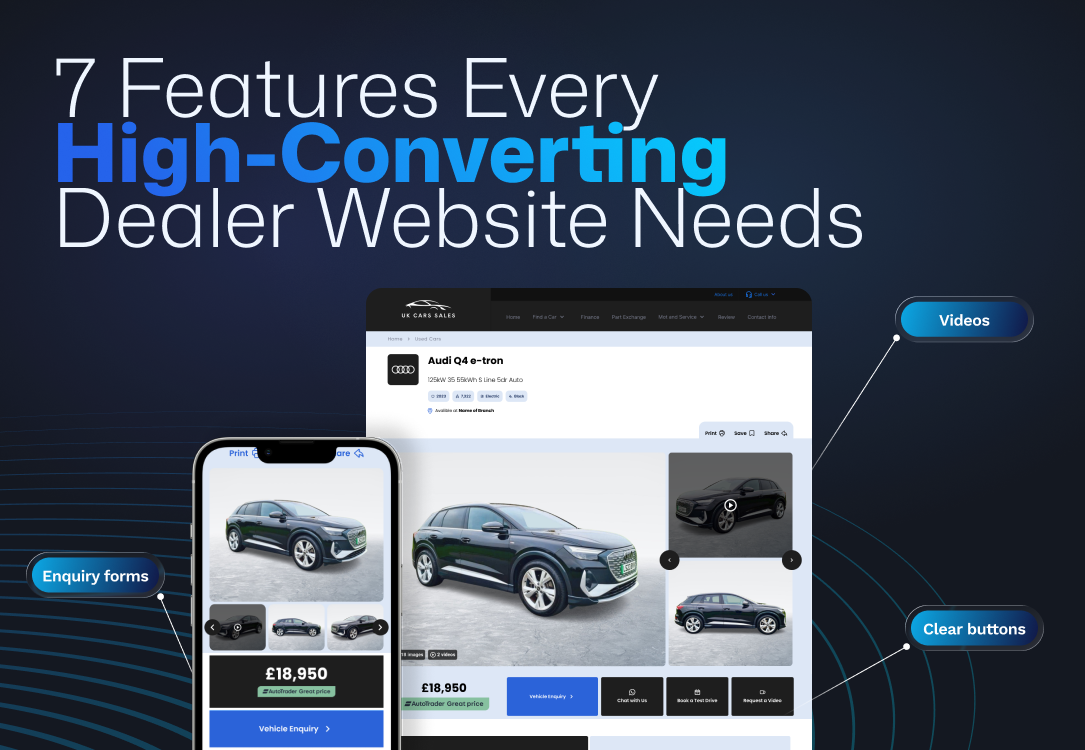
7 Features Every High-Converting Dealer Website Needs
Table of contents
A dealership website can have great stock, strong branding, and professional photography, and still fail to generate enough enquiries. That's because a high-converting car dealer website does more than look good. It helps buyers move from browsing to action. For independent car dealers, that usually comes down to a few key features. Not gimmicks. Not unnecessary complexity. Just the things that make it easier for customers to trust your business, explore your stock, and get in touch when they're ready.
If your website is meant to generate enquiries, these are the features it should include.
1. Fast load speeds
Speed shapes first impressions. If a buyer clicks onto your website and it feels slow, clunky, or unresponsive, you immediately create friction. And in most cases, buyers won't wait around, they'll go back and look at another dealer instead.
A fast website keeps people engaged for longer and makes browsing your stock feel easier. It also supports search visibility, which matters if you want more buyers finding your vehicles organically.
For dealer websites, speed is not just a technical issue. It's part of conversion.
2. A mobile-first browsing experience
Most buyers are not researching cars from a desktop during office hours. They are on their phones, comparing vehicles in spare moments throughout the day. That means your website needs to work properly on mobile from the start.
If stock pages are hard to scroll, forms are awkward to complete, or vehicle details are difficult to read on a smaller screen, enquiry rates will suffer. Buyers don't separate "bad mobile experience" from "bad dealership experience", it all becomes one impression.
A high-converting website makes mobile browsing feel simple, smooth, and intuitive.
3. Strong vehicle detail pages
Vehicle pages are where enquiries are won or lost. This is the point where a customer stops browsing and starts evaluating a specific car. If the page does not give them enough confidence, clarity, or incentive to act, the journey often ends there.
Strong vehicle pages help buyers make progress. They present the car clearly, answer key questions, and make the next step obvious. That usually means combining high-quality imagery, clear specifications, useful descriptions, visible pricing, and a well-placed route to enquire.
A good vehicle page should not just display the car. It should help sell it. How that stock is managed and presented behind the scenes, through your dealer management system, has a direct impact on what buyers see and how quickly pages stay up to date.
4. Clear and visible calls to action
Many dealer websites lose enquiries simply because they do not make the next step obvious enough. A buyer might be interested, but if they have to search for how to enquire, reserve, call, or apply for finance, some of that intent disappears. The easier it is to act, the more likely they are to do it.
High-converting websites guide users forward. They make the path to contact feel natural, not hidden. The best calls to action are clear, relevant, and positioned at the right moment in the customer journey, especially on stock pages and vehicle detail pages.
This connects closely to how your site's navigation is structured. If users can't find what they're looking for quickly, even a strong CTA won't save the conversion. Our guide to user-friendly navigation for car dealer websites covers that side of things in more detail.
5. Finance features that reduce hesitation
Affordability is one of the biggest questions in the buying journey. A customer may like the vehicle, but if they cannot quickly understand whether it feels financially achievable, they are less likely to enquire. That is why finance calculators and finance prompts are such an important feature on dealer websites. They help turn a headline price into something more practical and relatable, which reduces uncertainty and keeps buyers engaged.
Finance functionality also tends to improve the quality of enquiries, because customers are making contact with a clearer understanding of what may work for them.
6. Trust signals that build confidence
Before most customers enquire, they are making a judgement about your business. They are asking themselves whether the dealership looks credible, established, and professional enough to trust with a major purchase. That is why trust signals matter so much.
A high-converting website should help remove doubt. Reviews, testimonials, recognisable finance partners, professional design, and clear business information all play a role in making buyers feel more comfortable taking the next step. Trust does not sit in one section of a website. It runs through the whole experience.
We've covered this topic in depth separately: building trust through your dealership website is worth reading alongside this post.
7. A simple route to enquiry
The final feature is often the most important: making it easy to get in touch. A website can have all the right ingredients, but if the enquiry journey feels awkward or frustrating, conversion still drops. Buyers should not have to jump through hoops to contact your dealership.
The route to enquiry should feel quick and straightforward. Whether that means a short form, a call option, a reserve button, or another clear next step, the process should match the way customers actually behave online. When interest is high, simplicity matters.
What makes these features work together
No single feature turns an average website into a high-converting one on its own. What makes the difference is how these elements support each other.
A fast website keeps people engaged. A mobile-first experience makes browsing easier. Strong vehicle pages build interest. Trust signals remove doubt. Clear calls to action and simple enquiry paths make it easier to convert that interest into a real lead.
That is where high-performing dealer websites stand apart. They are not just built to showcase stock. They are built to help customers take action.
A website should generate enquiries, not just display cars
A lot of dealer websites look the part at first glance. The problem is that looking professional and converting well are not the same thing. If your website is missing key features — strong vehicle pages, clear calls to action, mobile-first usability, or visible trust signals — there is a good chance it is losing enquiries before buyers ever get in touch.
In many cases, dealers don't realise how much opportunity is being missed because the website is still "working", it's just not working hard enough. The strongest dealer websites do more than showcase stock. They create confidence, reduce hesitation, and make it easier for buyers to take the next step.
If you want to see what that looks like in practice, take a look at our portfolio to explore the kinds of websites we build for independent dealers and how they are designed to support real business growth.
And if you are ready to improve how your own website performs, request a website quote to see how Spidersnet could help you generate more enquiries.

Ready to transform your
dealership?
Let's chat about which package best suits your business.